

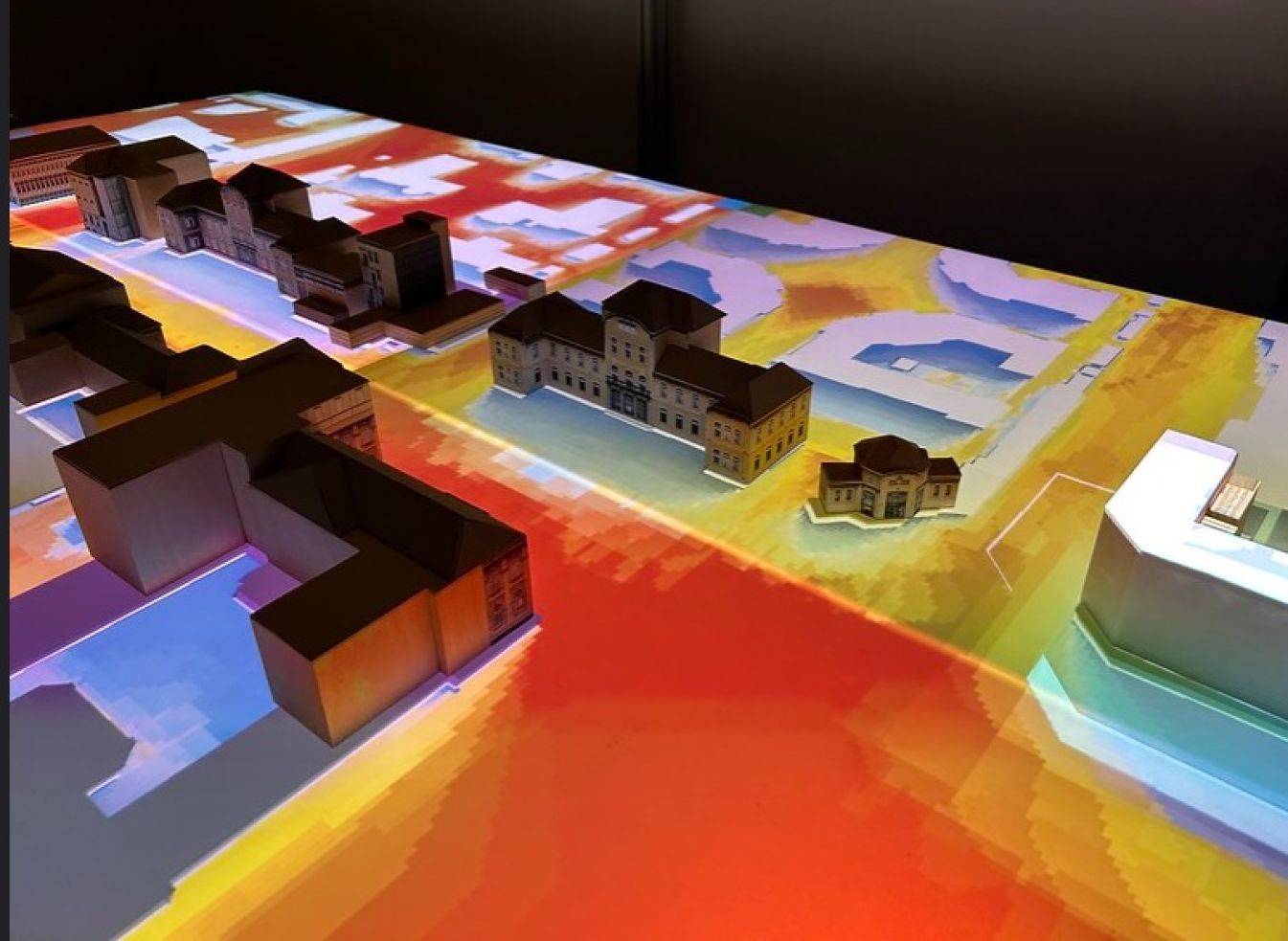
A physical and digital interface developed at Politecnico di Milano that makes participatory urban design more intuitive, accessible, and understandable even for non-experts
Within the framework of the exp-EIA project, research at Politecnico di Milano is experimenting with new approaches to make urban design processes more open, inclusive, and shared. These activities are presented by Gabriele Stancato, a researcher at the Politecnico, who introduces the Luminous Planning Table, a tool capable of integrating physical and digital dimensions to support participatory design.
The Luminous Planning Table is a physical and digital interface that helps overcome the technical barriers typical of three-dimensional visualization. “Designing directly in 3D requires specific expertise and skills,” explains Stancato, “whereas being able to physically take an object representing a building, move it on the table, and observe in real time the consequences of that choice makes the process more immediate and understandable even for those without a technical background.” In this way, the exp-EIA project encourages the involvement of citizens and stakeholders with different levels of experience, promoting more inclusive decision-making processes.
The table is equipped with a range of advanced features that allow users to simulate urban transformations and observe the effects of design choices in real time. It is possible, for example, to analyze the distribution of light and shadows between buildings, wind flows, the movement of people, and variations related to mobility and traffic. A complex system of projections represents what happens both at surface level—like on an urban map—and in space as a whole, including façades, roofs, and volumes.
A further innovative aspect introduced by the exp-EIA project concerns the simulation of the visual field of people moving through urban space. The Luminous Planning Table makes it possible to observe how the experience of urban space changes as the city layout transforms, even in real time. The tool thus emerges not only as a support for design, but as a true technological innovation device, capable of making the future of cities more legible, shared, and participatory within the MUSA research ecosystems.