

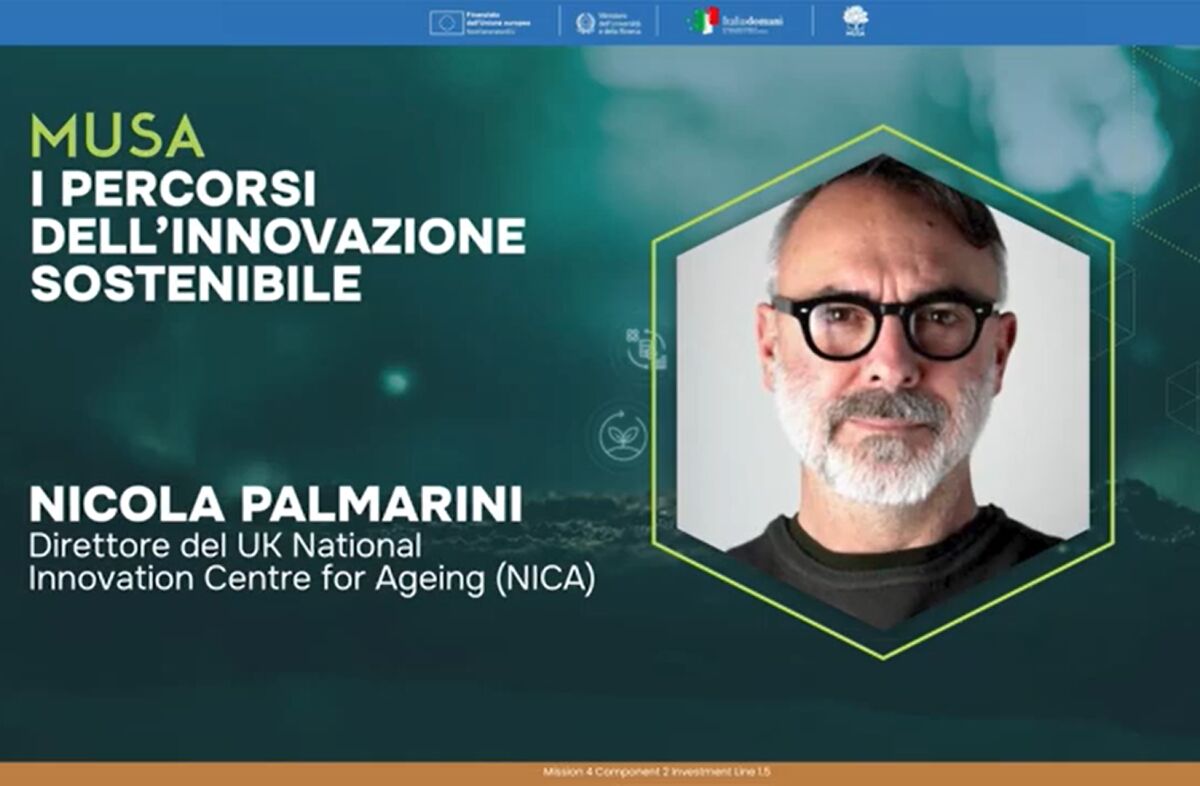
From urban planning to widespread wellbeing: the director of the UK National Innovation Centre for Ageing explains why cities must become active protagonists of longevity.
Cities have long been imagined as containers to be adapted to an aging population. While this is the dominant approach today, Nicola Palmarini, director of the UK National Innovation Centre for Ageing (NICA), believes it is no longer sufficient. Cities can and must take a much more active role in determining the quality and duration of people’s lives.
“We have always thought of cities as something that must adapt to an aging population. In reality, cities can do much more: they can become an active driver of people’s longevity,” Palmarini explains. Every urban element, even the most mundane, contributes to building this perspective. It is not just about healthcare infrastructure, but the entirety of the experiences that define life in the city.
“A park, a shop, a restaurant, a means of transport: each of the elements that constitute the city can help people live longer and healthier lives,” he emphasizes. It is within these urban touchpoints that the possibility of transforming the city from a simple backdrop into a true enabler of wellbeing is played out.
To achieve this, however, a paradigm shift in terms of expertise is required. Urban longevity cannot be addressed by a single discipline; it requires an integrated vision. “We need a new urban discipline in which different skills begin to interpenetrate: from the urban planner to the sociologist, from the psychologist to those dealing with active lifestyles, all the way to the nutritionist. It is no longer the responsibility of just one person, but a collaboration—an orchestration of elements that contribute to longevity.”
A decisive role belongs to public administrations. According to Palmarini, governing a city means returning to the fundamental principle that the wellbeing of citizens must be the absolute priority. “The role of those who govern is not just to manage bureaucracy, but to re-center the principle that the welfare and wellbeing of citizens are the supreme law,” he asserts. This is a mission that cannot remain confined to social policy or health departments. “Every city councilor has a responsibility for the longevity of the citizens. Even moving a bus stop means asking what impact it will have on people’s health and quality of life.”
Alongside the role of institutions, citizen involvement is fundamental to ensure that urban policies respond to the real needs of people throughout their entire life course. This is because, as Palmarini clarifies, longevity does not simply mean growing old. “We must decouple the concept of longevity from that of old age. Longevity means healthy life expectancy, and this is built across the lifespan, not just when one reaches a certain age.” This approach opens a new perspective on urban and social policies, which must be designed with an intergenerational focus and aimed at helping us reach old age in good health. “We need to get there healthy, not sick,” Palmarini reiterates.
In this scenario, universities play a crucial role as mediators and translators of models. Universal solutions that work everywhere do not exist: every strategy must be tailored to specific cultural and territorial contexts. “You cannot assume that a model that works in Buenos Aires will work the same way in Helsinki. We need to understand which fundamental elements can be translated and interpreted according to local cultures.” Through research, data analysis, and the definition of performance indicators, the academic world can help cities read the health status of their populations and understand if the policies adopted are truly moving toward greater healthy longevity.