

From Space Economy technologies to post-PNRR challenges: how research can evolve into high-impact enterprises.
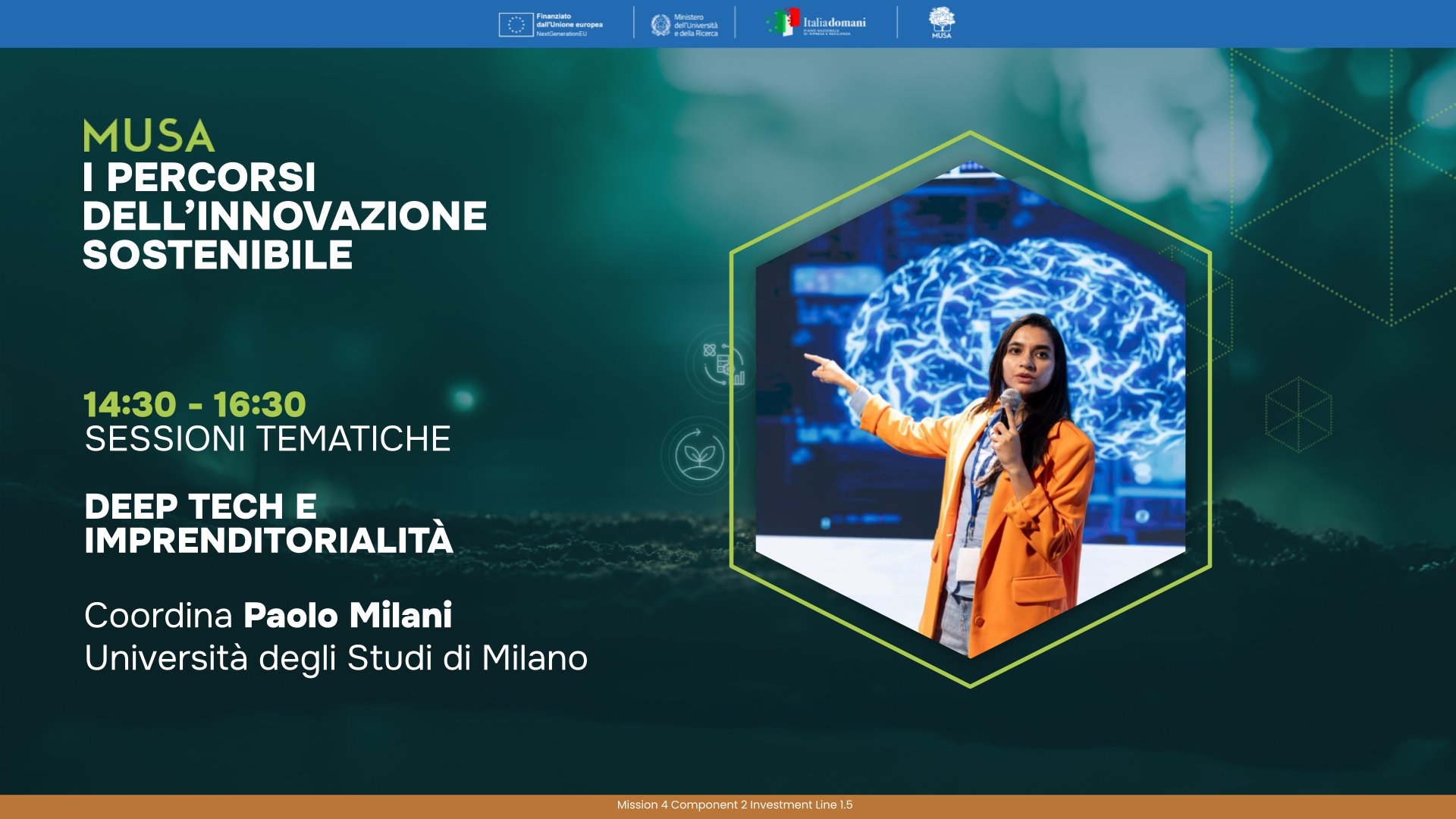
As the 3–4 December event approaches, it offers an opportunity to explore one of the three core themes of MUSA’s parallel sessions: Deep Tech. Leading this session will be Professor Paolo Milani, Director of the Department of Physics at the University of Milan, who in this interview discusses which technologies developed within the ecosystem are ready to become industrial success stories, how Milan’s academic entrepreneurial landscape is evolving, and which conditions are essential to transform prototypes and research into high-impact new ventures.
Interview with Paolo Milani – Director of the Department of Physics (University of Milan)
Which Deep Tech technologies developed within MUSA do you believe are ready to become industrial success stories in the coming years?
I consider particularly promising the technologies developed in the field of the Space Economy, and in particular those related to optical telecommunications for satellite networks. Within MUSA we have succeeded in developing several innovative solutions and in creating a start-up that is currently finalizing a seed investment round. It is certainly a strong candidate to become a success story.
How is the academic entrepreneurial ecosystem in Milan evolving, and what role does MUSA play in making it more internationally competitive?
The university system in Milan is gaining, as a whole, increasing awareness of the importance of technology transfer, and this supports the growth of a more mature entrepreneurial ecosystem. An essential goal is to create stable development links with major companies. This is a target not yet achieved and will require major efforts and determination in the future.
Which skills or infrastructures are most decisive today for attracting investors in the Deep Tech field?
There is a need for infrastructures where it is possible to prototype, validate and characterize the proposed solutions for venture creation; without deep-tech infrastructures, there can be no deep-tech enterprise. Academic research laboratories, although well equipped, cannot be sufficient on their own.
In the transition “from a PNRR project to a stable innovation platform,” what challenges and opportunities do you see for transforming prototypes into new companies?
The opportunity lies in moving beyond an academic dimension and shifting toward a fully industrial dimension, one that is more suitable for engaging with the actors of innovation. The challenge is to be able to intercept innovation coming from academia and turn it into a product with high economic and social value.
What kind of collaboration between researchers, start-ups and SMEs do you consider essential in the post-PNRR phase?
I consider it essential to create a value chain governed by the MUSA platform. The experience acquired during the PNRR phase should become the enabling factor for fostering productive dialogue among all the parties involved.