
From the concentration of patents to students’ economic vulnerability, and up to universities’ energy consumption: a snapshot of the strengths and critical issues within the Italian higher education system.
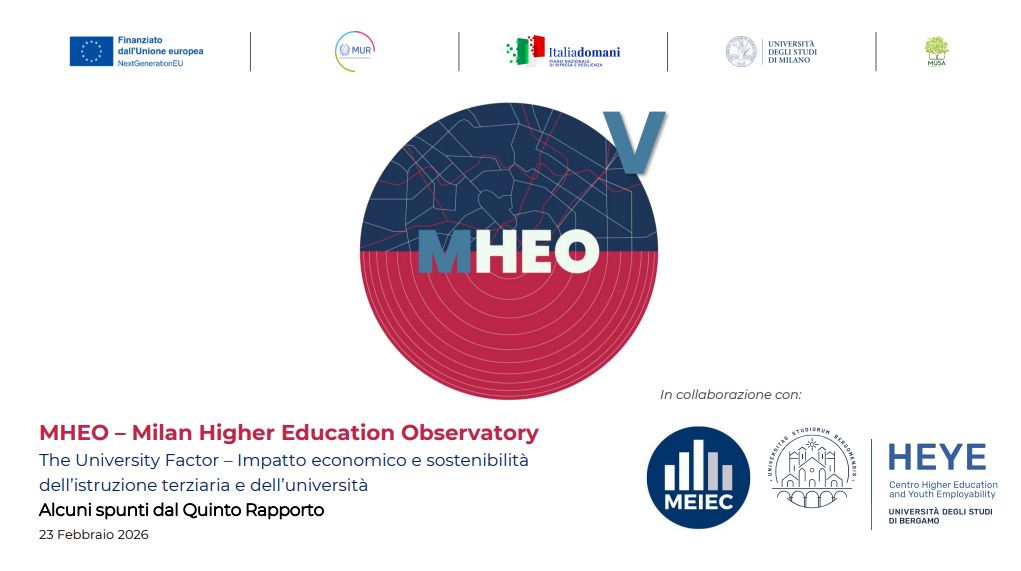
The university system as a driver of economic and social development, but also as an organization called to address structural sustainability challenges. This is the common thread running through the Fifth Report of the MHEO – Milan Higher Education Observatory, presented on February 23 as part of MUSA’s activities.
The Report, titled “The University Factor – Economic Impact and Sustainability of Tertiary Education and Universities”, systematically analyzes three dimensions: the evolution of tertiary education, the economic and social impact of universities, and the environmental, social and economic-financial sustainability of Italian universities.
Patents and spin-offs: innovation still concentrated
Regarding the Third Mission, the Report highlights significant growth in university patenting activity in Europe (+64.5% between 2000 and 2020), with Italy accounting for 6.6% of European academic patent applications. However, the system remains highly polarized: a small number of universities account for around 50% of granted patents, and Northern Italy represents 47% of the national total, with Lombardy leading at 29%.
A similar territorial concentration emerges for university spin-offs, largely located in the North (47%) and primarily generated by large universities. After peaking in 2018 (86 new spin-offs), the number of new initiatives dropped to 20 in 2024, due to post-pandemic uncertainty and a more restrictive regulatory framework. Research-based companies show good survival rates but remain small in size and demonstrate limited international growth.
Students and economic vulnerability
One chapter focuses on the economic and financial well-being of students at the University of Milan. The data highlight widespread vulnerability.
57.6% of students do not work and rely on family support, while about one-third of working students face significant hourly workloads, creating a substantial trade-off between employment commitments and academic continuity.
One-third of students can cover a maximum of €100 with their own resources, and those unable to save show higher rates of anxiety (56%) and depression (40%) compared to peers with greater financial stability. Rent represents the main expense for those living away from home (approximately €730 per month), with direct impacts on the quality of university life.
In this context, financial literacy directly affects psychological well-being, with marked gender gaps: 55% save without dedicated financial tools, highlighting limited financial education and uninformed financial management.
Sustainability: progress made, but self-production remains marginal
Section III addresses university sustainability across three pillars – environmental, social, and economic-financial. Between 2015 and 2021, energy consumption in Italian universities increased by 24.1%, while self-production, despite growing by 300%, still covers only 2% of total demand. This highlights significant room for improvement in terms of efficiency and renewable energy production.
From a financial perspective, the ratio between university tuition fees and the Ordinary Funding Fund (FFO) decreased by 25% between 2016 and 2023, signaling growing dependence on public transfers. Overall revenues have remained substantially stable over the past decade, thanks to the strengthening of the FFO, which offset the decline in student contribution revenues.
An observatory for evidence-based policies
Promoted by the University of Milan and integrated into Spoke 6 of MUSA, MHEO was established to monitor the Milanese and Lombardy tertiary education system through an evidence-based approach, strengthening dialogue between universities, businesses, and public administrations.
The Fifth Report confirms that universities represent a strategic factor for territorial competitiveness and social cohesion. At the same time, it clearly outlines the structural tensions affecting the system: concentration of innovation, economic vulnerability among part of the student population, increasing dependence on public funding, and delays in the energy transition.
A multifaceted picture that calls for renewed governance, funding policies, and stronger integration between teaching, research, and third mission activities to make tertiary education increasingly sustainable and inclusive.